

Restoration Planting
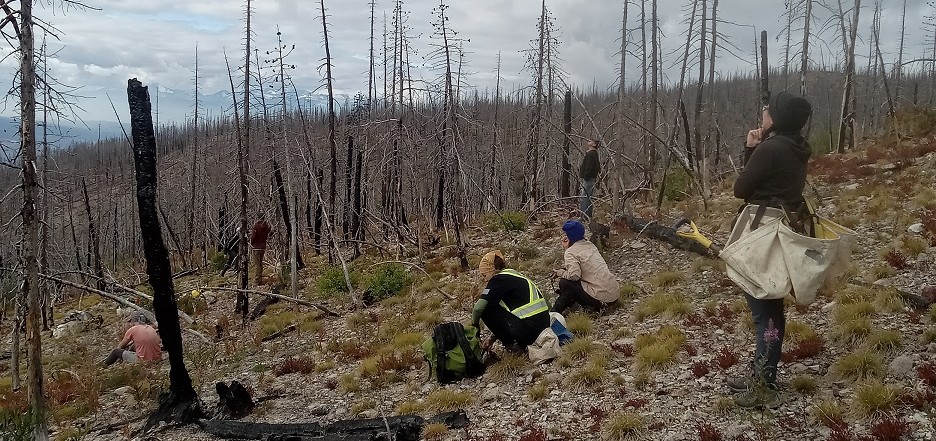
Since 2011, the BVRC and its partners have established whitebark pine restoration plantings at 31 sites across north central BC, totaling approximately 316 ha. There have been six main types of restoration:
- plantings in recent wildfires (18 sites in 5 wildfires);
- operational planting in forest cutblocks (2 sites);
- assisted migration trials across an elevational gradient (4 sites on Hudson Bay Mountain, 2 sites on McBride Peak);
- high elevation mine reclamation (2 sites);
- alpine pilot planting (1 site); and
- periglacial pilot planting (2 sites)
We have also supplied seeds to industrial users in the Skeena Region (e.g. BC Timber Sales to assist including whitebark pine in operational reforestation of logged areas within whitebark pine habitat). Please contact us if your organization is interested in being involved in whitebark pine restoration activities in the Skeena Region.
Below is a map of our restoration plantings
A 1300 ha wildfire burned in the Gosnell Creek watershed in August 2010. This valley has high value grizzly and black bear habitat due to abundant salmon, avalanche tracks, huckleberries, and ridgetop stands of whitebark pine. Drier sites within the burned area are suitable for whitebark pine restoration plantings.
We selected two contrasting sites in the Gosnell Valley for our first restoration trial in 2011:
- The Crystal Road site is a dry rocky ridge (ESSFmk/02a site type) that was severely burned by the wildfire.
- The Joshua Road site is a dry glaciofluvial outwash terrace (ESSFmk/02b site type) where the lodgepole pine overstory was killed by mountain pine beetle. The wildfire was spotty and of low severity at this site.
In June 2011 we planted 50 whitebark pine seedlings (mixed non-local seedlots grown at UNBC) and sowed seed caches (Mount Sidney Williams seedlot) at each site. We return to the site intermittently to measure the survival, growth and condition of the planted and seeded tree seedlings and to remove competing vegetation. We expect the seedlings on the severely burned Crystal Road site to grow faster due to full sunlight and nutrient release after the burn. One half of the planted seedlings received one cup of soil taken from beneath a mature whitebark pine tree growing nearby in order to inoculate the soil with appropriate mycorrhizal fungi. Laboratory research conducted by Hugues Massicotte and Linda Tackaberry at UNBC suggests that mycorrhizal inocula may improve the growth of young whitebark pine seedlings.
At the Joshua Road site we found dozens of naturally regenerated whitebark pine growing beneath the dead lodgepole pine. These trees apparently grew from Clark’s Nutcracker seed caches. We have flagged these seedlings and are following their progress to determine whether they are able to release and grow to maturity following death of the overstory lodgepole pine. Most of these naturally regenerated seedlings are infected with white pine blister rust.
Five years after planting, the largest, healthiest seedlings were planted in a small burned clearcut. Seedlings planted beneath burned snags in a severely burned forest were intermediate in size. Seedlings planted beneath mountain pine-killed overstory trees in a lightly burned forest were smallest because they experienced minimal nutrient release from the fire and the most competition and shade from surrounding live and dead vegetation. Survival was excellent except in very shallow burned soils at the top of a south-facing rock outcrop where a few seedlings died from heat injury and drought in the first year. Some seedlings located at the base of snags (mainly germinants from direct seeding) were damaged by sloughing bark.
In 2004, a wildfire burned on the shoreline of Kidprice Lake adjacent to the Nanika River falls within what is now Nenikëkh/Nanika-Kidprice Provincial Park, co-managed by BC Parks and the Wet’suwet’en Nation. The wildfire killed many large whitebark pine trees. Although Clark’s Nutcrackers are commonly seen at Kidprice Lake, a regeneration survey found only a few, tiny whitebark pine seedlings growing in the burned area. Lodgepole pine and subalpine fir regenerated well after the fire and are growing much more rapidly.
The BVRC has been working with BC Parks and the Office of the Wet’suwet’en to restore whitebark pine stands within the Nanika wildfire. Seedlings grown from seeds collected from a young stand on the shore of Kidprice Lake directly opposite the wildfire were planted on rocky outcrops within the wildfire in 2014 (340 seedlings) and 2017 (1500 seedlings). All of the parent trees from whom the seeds were collected were free of active white pine blister rust, and we are monitoring their offspring for evidence of blister rust resistance, both in the Nanika wildfire and in field and laboratory trials conducted in the US and in southern BC. At this site there was some early mortality of seedlings planted in the most shallow, rocky soils in both years (2014 and 2017) and some uprooting of 2017 seedlings by a bear. Monitoring results from September 2019 indicate that seedlings that survived their first summer are growing well and there is no evidence yet of white pine blister rust infection at this site.
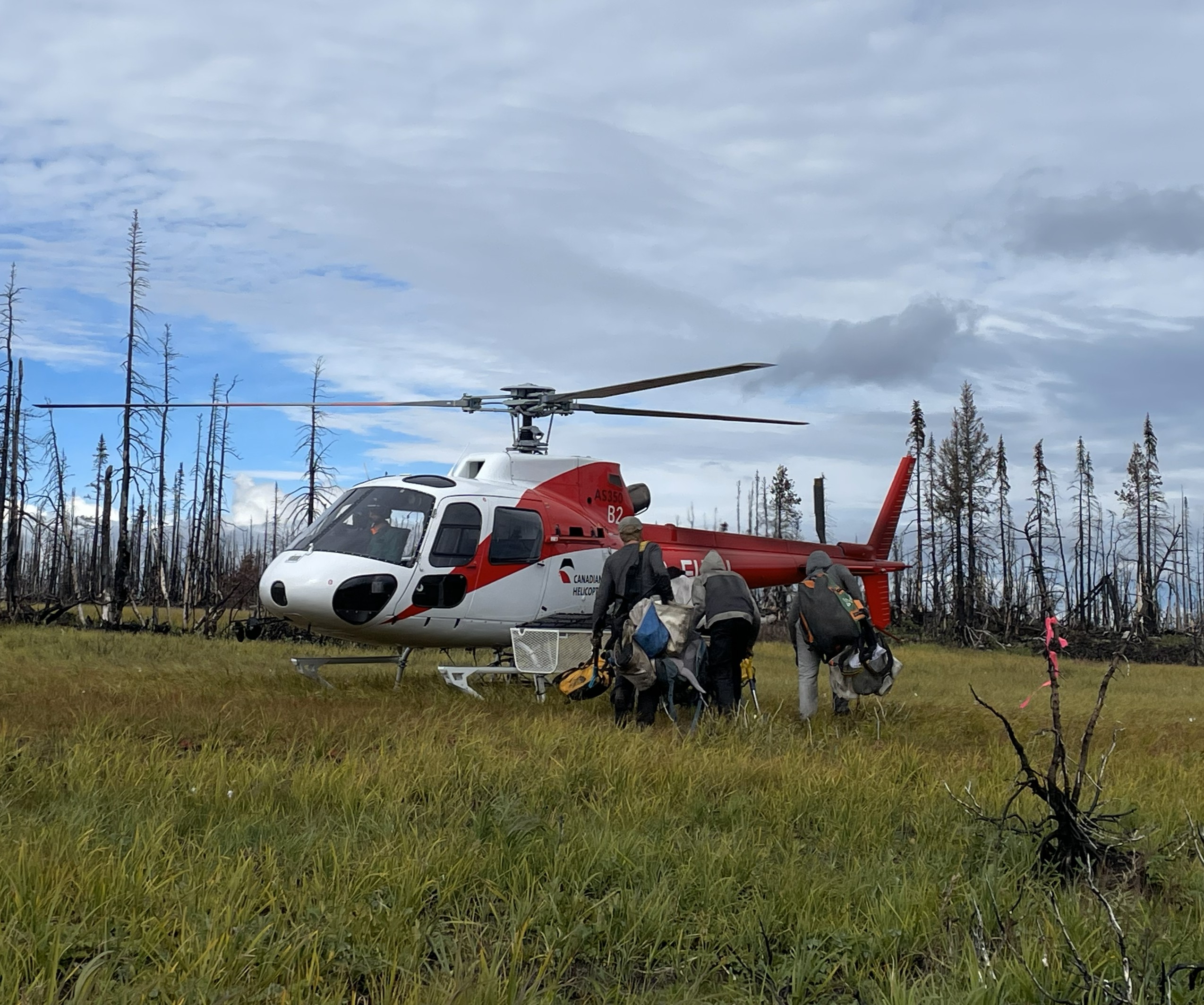
The 2012 Atna wildfire burned an extensive area in Morice Lake Provincial Park including significant stands of whitebark pine. The BVRC worked with BC Parks and the Office of the Wet’suwet’en, who co-manage the park, and the BC Wildfire Service to identify suitable sites for restoration with putatively blister rust-resistant whitebark pine seedlings. Seedlings grown from seeds collected at Kidprice Lake (see Nanika wildfire) were planted on a remote rocky ridge above Atna Bay by firefighters from the Burns Lake Unit Crew in 2014 (340 seedlings) and 2017 (3300 seedlings).
Additional seeds were collected from rust-free parent trees on Nanika Mountain within Morice Lake Provincial Park to continue this restoration project.
Monitoring of the Atna wildfire restoration trials (most recently in September 2019) has indicated outstanding survival and early seedling growth in this wildfire. There is abundant Ribes in the wildfire area and 5% of the seedlings planted in 2014 have already been damaged (1 killed) by white pine blister rust. It appears that some of the largest and healthiest seedlings were the first to be infected and damaged by the rust. While this mortality is unfortunate, it was not unexpected, and it will help us to determine which of the seed families are most susceptible and most resistant to white pine blister rust under field conditions.
In 2023 the BVRC partnered with Cheslatta Carrier Nation to plant 9,100 seedlings in the X wildfire. This area was one of the more dry and rocky sites we have planted in. No monitoring trees were established to track the success of the seedlings.
Blanchet Lake is in north Tweedsmuir Provincial Park. All trees were killed in a 2018 widlfire and before the wildfire, some of the mature whitebark pine and lodgepole pine were killed by mountain pine beetle. To date we have planted along the north shore of this lake at three different sites, totaling 89 ha and 45,500 seedlings. The site has been slow to regenerate new seedlings, so the whitebark pine we have planted are not being outcompeted.
This site is easily accessed via float plane, and now we have to use a canoe to transport the seed boxes to new caches as the planters move down the lake.
In 2024, a wildfire burned a large area along the northwest flank of the mountain. Although the fire came close to several of our cone collection trees, the fire perimeter did not reach them. Substantial fire damage occurred throughout whitebark pine habitat in this area, creating new restoration opportunities to explore in the future.
For the first time, we planted seedlings in the year immediately following the fire. While we routinely assess survival after one year of growth, this site will be monitored closely to evaluate whether post-fire planting in the first year represents a viable restoration approach.
The Higgins Creek site is located in Babine Provincial Park. The planting site is ~1660 m in elevation in an alpine plateau at tree line. The mature trees grow in groups of krummholz or as sparsely spaced individuals surrounded by heather, lichen, exposed mineral soil, and rocks. There may be some whitepine blister rust infection on the surrounding mature whitebark pine, but scars caused by the harsh growing conditions made it difficult to be certain. We planted 546 seedlings (none elite), with a ~287 stems/ha density, in a 1.9 hectare area in one day. First year monitoring shows a 95% survival rate after the first growing season.
Nanika Lake is located in Kidprice Provincial Park. The area chosen to plant is around 860 m in elevation, and within a glaciofluvial fan that was affected by mountain pine beetle and white pine blister rust. More than 50% of the mature whitebark pine and lodgepole pine were killed, resulting in an open canopy. The site was variable with patches of mature live trees, dead trees, and interspersed conifer seedlings. The ground was also variable, with patches of lichen, exposed mineral soil, and dwarf shrubs. In fall 2025, we planted 6,337 seedlings (1,320 were elite), with a ~476 stems/ha density, in a 13.3 hectare area in one day.
In fall 2025, we planted on the north side of Sibola Mountain, near the snowmobile cabin, in an area without a major recent disturbance but rather just low tree density. This will provide a good site to explore how the seedlings will succeed without disturbance and low live mature tree density (we have previously planted in an undisturbed area in Babines but it was at treeline in a very different ecosystem). In one day, 3,405 seedlings were planted, with 594 seedlings from known elite blister rust resistant parent trees.
Since 2012, the Wetzin’kwa Community Forest near Smithers has collaborated with the BVRC to include whitebark in its planting operations. In 2017, contract planters planted 1,400 seedlings from local rust-resistant parent trees at a high elevation cutblock above the McDonell Lake Road.
Pacific Inland Resources, a division of West Fraser Inc, planted its first 214 whitebark pine seedlings at a high elevation cutblock located north of Reiseter Creek.
In 2021 the BVRC partnered with Cheslatta Carrier Nation to plant 1,350 whitebark pine an operational cutblock that was salvaged logged after the 2018 Nadina wildfire.
Since 2012 the BVRC has been working with the Wetzkin’Kwa Community Forest Corporation to establish whitebark pine seedlings on the west side of Hudson Bay Mountain near Smithers. Our trial compares the growth of whitebark pine seedlings at 4 elevations in order to help understand how climate change may influence the future success of this tree in the Smithers area. Currently whitebark pine trees grow largest and produce the most cones at elevations around 1000 meter but these trees may be most vulnerable to stress under a warming climate.
- Low elevation site – at the Duthie West trailhead (1000 m elevation)
- Transitional site ̶ on a rock outcrop near the lower end of the Piper Down mountain bike trail (1100 m elevation) just below Hudson Bay Mountain main ski lodge (1300 m elevation)
- Mid-elevation site ̶ near the near the Pay Dirt mountain bike trail just below Hudson Bay Mountain main ski lodge (1300 m elevation).
- High elevation site – at timberline on the Hudson Bay Mountain Prairie (1600 m elevation).
At the low, mid and high elevation sites, the Wetzin’Kwa planting crew helped us plant 90 four-year-old seedlings grown at UNBC. At the high elevation site, we also direct-seeded 31 caches with 5 seeds each. We will return once or twice per year to measure the survival, growth and performance of the planted trees and to remove competing vegetation.
The high elevation site has a climate station maintained by the BC Forest Service to study climate change and is located adjacent to an assisted migration seedling trial established in 2007 by Sierra Curtis-McClane, a graduate student in the UBC Centre for Forest Conservation Genetics. As the climate warms it will be informative to learn how well whitebark pine trees can grow in an alpine zone that was formerly too stressful for tree growth.
Survival of seedlings planted in 2012 has been excellent (~97%), but seedlings planted in 2014 at the transitional site suffered heavy mortality due to hot, dry weather. To date, it appears that seedlings planted at lower elevations grow most rapidly in height, while those planted above treeline grow most rapidly in diameter. To date, we have not yet detected any operationally significant effects of tree provenance (the geographic origin of parent trees) on field survival or early growth of seedlings this trial, suggesting that trees from a wide variety of geographic locations can be expected to perform well in a range of outplanting climates. This result is consistent with genetic work on whitebark pine carried out at UBC.
Read the 2014 establishment report and 2018 5-yr results from this study.
In the McBride Community Forest located on McBride Peak, in the western Rocky Mountains, we established a second installation of the assisted migration trial in July 2013. The trial used the same 5 seedling provenances grown at UNBC in the same subalpine and alpine soils as at Hudson Bay Mountain, but the seedlings were 5 years old when planted and were planted at two elevations, a subalpine/timberline site at 1828 m and an alpine tundra site at 1925 m. Treeline elevations are at least 200 m higher in the Rocky Mountains than they are at comparable latitudes in the western mountains.
A video (Operation Whitebark) prepared by treeplanter Darren Rockcliffe documents the planting operation.
Fifth growing season results from McBride Peak were similar to those at Hudson Bay Mountain. Survival was excellent (95%), growth was very slow with few differences among provenances, and alpine seedlings were sturdier than those planted in the subalpine. But alpine seedlings had more needle loss from winter exposure. At McBride Peak, 5 seedlings had white pine blister rust, compared to only one at Hudson Bay Mountain.
In 2014 we supplied 500 whitebark pine seeds collected on Mount Sweeney to Huckleberry Mines for a reclamation trial located at their mine site adjacent to Tahtsa Lake. One year old seedlings grown at Tipi Mountain Native Plant nursery in Cranbrook, BC were planted by DWB Consulting Services on a south-facing dam face along with other native plants in mid-May, 2016. By September 2016 approximately 80% of the seedlings were dead. Other conifers planted at the same time did not experience the same levels of mortality. It appears that the combination of an extreme site (poor, drought-prone soils; exposed location; low elevation for whitebark pine), small seedlings, and perhaps the lengthy travel distance from the nursery contributed to poor success in this trial.
Artemis Gold Inc proposing to develop its Blackwater Gold mining project on Mount Davidson, located 100 km south of Vanderhoof, BC. An isolated stand of whitebark pine was discovered within the proposed mine project area. The BVRC has been working with the engineering firm AMEC and the Whitebark Pine Ecosystem Foundation of Canada to help restore the whitebark pine ecosystem on Mount Davidson. Whitebark pine seedlings were salvaged in summer 2012 from within the mine footprint and were planted at a nearby restoration site. In 2013, seeds were collected from blister rust-free parent trees on Mount Davidson and seedlings grown from these parent trees at Woodmere Nursery were outplanted at the restoration site in 2015.